AI Coding 2026
28 Aug 2026
Software development in 2026 is wild. I thought it’d be fun to share one of my recent Claude Code sessions working on a fun and frivolous game that my daughter and I have been building together, to give a taste of what it’s like to build software in 2026.
AI coding is a builder’s paradise where my favorite programming quote is more true than ever:
“The programmer, like the poet, works only slightly removed from pure thought-stuff. He builds his castles in the air, from air, creating by exertion of the imagination. Few media of creation are so flexible, so easy to polish and rework, so readily capable of realizing grand conceptual structures.”
— Frederick P. Brooks Jr.
If the thing you’re building is easily verifiable (in this case: does the game actually play and does it look good?), and you have a sandbox for your agents, then you can work almost entirely in the higher order problem space, preserving mental capacity for providing the creative vision. The goal is to stay above implementation details, only providing guidance on the general shape and architecture. New projects need more steering, but then the flywheel kicks in and eyes-off “vibecoding” becomes possible (slop free if done right).
In the beginning I thought I’d miss the mechanical act of coding, which can be both therapeutically calming (when you reach flow state) and also exciting like a good puzzle. But this new world of higher order creation is just too much fun, I’ve ended up not really missing hand writing code. I find it interesting that this new model is no less mentally exhausting than the old, it’s just all happening in higher order information space.
The session below produced about 18,000 lines of code across multiple projects. This would have taken weeks if not months of manual coding effort in the before times.
Without further ado… The Wizard:
New village character: The Wizard
The Wizard is another member of the builder group, but his role is to predict the kinds of features the village will want and automatically builds them. He materializes their sub quantum forms into reality by magic incantations.
The Wizard lives high on a mountain top to the west (expand map Westward to make room for his mountain) in a skyscraping tower. The top of the tower is literally above the clouds. The mountain is by far the biggest thing in the game, at least 8 times taller than the pyramid. Trees, streams, etc (use objects from the free store if available).
Twice a day the Wizard summons a dew drop distilled from a cloud that hangs over his tower and directs it to the plaza. When it hits, the build is announced. It travels slowly from the tower to the plaza the whole time the Wizard builds (accelerating if he finishes early).
The idea generation pipeline is the whole magic of the wizard and most important aspect of this build. The pipeline should use a variety of models to analyze git history, Dot bulletins, and player interaction (we should start tracking engagement with different village features). The ideas must be truly compelling and fun. Some should be exceedingly beautiful. Some should be exceedingly simple. Some should be obvious. Some should be novel and surprising.
The idea generator sends its ideas to Gus after filtering through a few alternatives. Rejected ideas should be stored but never consulted during idea generation. Instead, future engagement that leads to a rejected idea being implemented and subsequently well engaged with should be tracked as a signal for future ideas. Challenge will be with weighting these signals. A/B testing of prompt or settings changes in the idea generation pipeline will be critical from v0. Human engagement feedback is gold.
They show up on Gus’s desk on fancy wizard scrolls with hand written notes (find the most wizard-ey available font online) written in the voice of the Wizard. Think Gandalf (the grey in levity, the white in wisdom) in terms of voice. Same interaction model as Gus, just different styling and voice.
Claude spent the next stretch reading — the architecture docs, the builder pipeline, the desk, persistence, the map bounds, how NPCs are placed, how a panel is drawn. About forty files.
I want you to be very conservative with your token usage so that you can keep my input very fresh in your context.
You must demand that the sandbox return an extremely concise summary of what it did, and you should potentially not even read all of the code that gets written
I’m providing narrative that will be more important than implementation details
How shall we travel to see the Wizard?
The first time you travel there you arrive at the bottom of the hill (think The Royal Mile in Edinburgh Scotland) on a cobble stone road leading up to the wizard’s tower. There’s a whole wizard-ey world up there and village of its own.
You have to get to the top of the tower once manually to unlock it as a travel destination.
The tower itself has ledges circularly ascending around the whole tower you have to jump up.
Understood — concise summaries, minimal reading on my side, and your narrative leads. Folding the Royal Mile, the unlock-by-climbing rule and the jump-up ledges into the client round now. Writing the three handoffs and launching in parallel.
Pulling up the wizard’s ball brings up Gus’ interface completely reskinned as the wizard’s magic ball thing
Only a reskinning
Noted: the crystal ball at the tower opens Gus’s desk, wholly reskinned — same data, same buttons. That goes to the desk round (C); the world round (B) only builds the ball. Writing B and C now, then launching all three.
Three sandboxes launched, each sonnet with two opus review loops behind it.
Three sandboxes are running in parallel:
| round | branch | what |
|---|---|---|
| A1 | sbx-wizard-ledger |
engagement ledger (actions per message type + presence per landmark, per day, persisted), /engagement.json, the map’s west edge to z -540, two carpet landmarks (foot of the Royal Mile; tower top, unlocked per account by climbing it once), and the plumbing the Wizard’s brain needs |
| B | sbx-wizard-mountain |
the mountain (520 tall, from one height function), the cobbled Royal Mile with its crooked houses, streams, the summit village, the tower with jump-up ledges, the cloud deck, the crystal ball, the Wizard’s mesh, the dew drop’s flight and splash, and the carpet honouring the tower-top landmark |
| C | sbx-wizard-ball |
the desk reskinned as the crystal ball (one panel, a skin class, one extra CSS block), the Wizard’s dockets drawn as parchment scrolls in Uncial Antiqua / MedievalSharp, and a ui-shot -P ball page |
Round A2 — the Wizard himself: his NPC row and persona, the twice-a-day dream (four muses on four models × four lenses → an opus-class judge → one scroll to Gus, rejected ideas stored and never re-read, lessons from rejected ideas the village later built anyway, A/B variants logged per idea) — launches once these three are integrated, since it stands on all of them.
Assumptions I made, so you can redirect while they run:
- Talking to the Wizard is conversation (Gandalf persona, honest that the dew drop does the building — the same no-actuator rule as DJ Nova); his ideas reach Gus only through the twice-a-day drop.
- The Wizard’s builds land as ordinary previews with the ordinary Promote button — nothing auto-ships to prod.
- Google Fonts are loaded from the desk panel with a cursive fallback (assumes the tablets have internet).
The first sandbox finished with no commits: it had started the test suite in the background and then stopped to “wait for it”, which in a headless session is an exit. Claude lifted the uncommitted work out of the clone as a patch and relaunched with the patch embedded in the brief — and sent the other two a warning.
A1 ended with no commits — it started the smoke suite in the background and stopped to “wait”, which in a headless session is an exit. The work is still in its clone ($7.37 spent). Rather than re-run from zero, I’ll lift the diff out of the clone (plain diff, no git in there) and hand it to a fresh round whose handoff says: apply this patch, run the suite in the foreground, commit before verifying.
An hour later all three branches were in. The opus review legs on two of them had died mid-run of a revoked OAuth token, so Claude merged everything onto one branch, ran the suite on the host — 1495 assertions, 0 failures — and ran a full code review of the merged branch itself.
Thoughts on the design? Nailing the world feel will be critical. We’ll need to do several more rounds of this after this
Yes — a few, mostly about the world.
The mountain’s feel is a silhouette problem, not a detail problem. From the plaza it’s 750 units away; what reads at that distance is the outline and the cloud line. The cheap wins are: foothills (two or three lower bumps in front so it isn’t a lone cone), the road visible as a pale thread winding up, the cloud deck genuinely hiding the top so the tower pierces it — and then the reveal when you climb up through the clouds, which is the payoff of the whole climb. That reveal is worth a round of its own: fog colour, the deck’s thickness, the moment the sky clears.
One unfogged mountain in a fogged world will look pasted-on. The pyramid gets away with fog: false because it’s a flat-colour icon. A 520-unit mountain wants a distance tint of its own (a fake aerial perspective — bluer and paler with distance in the vertex colours) rather than no fog at all.
The climb rhythm decides whether kids go up twice. 28 jumps of 4 units is a slog if every ledge is the same. Mix the language: a run of ledges, a short spiral stair, one scary gap, a landing with a view, repeat. Elsie is the test; but a sandbox can’t judge it, and neither can a screenshot. That one wants her.
The Royal Mile needs life, not more houses. A crooked street with nobody on it is a diorama. Next rounds: two or three wizard-village NPCs with their own voices (an apothecary, a broom-seller, a cat that talks in riddles), wind and chimes as ambient sound, a stream you can wade, shop signs a kid can read. And the philosophy test — what can she make up there? A spell shop where kids name a spell and the Wizard’s next scroll is nudged by it would tie the world to the pipeline.
The dew drop is the one shared spectacle, so it should be visible from everywhere: bigger than physics suggests, a sky-trail, maybe a faint hum. Kids should look up and say “it’s coming”.
On the pipeline: the four lenses are right, and the judge is the taste. The weakest link is the ledger — message types are a coarse proxy for “what’s fun”. Presence-at-landmark is the better signal, and later a third: replays cued (things worth filming are things worth doing). Lessons-from-rejections is the interesting loop; keep it a small weight until there are twenty data points.
Process for the feel rounds: each one should be a vista — “the view from the plaza”, “the foot of the road”, “through the clouds” — with the sandbox taking photos and me putting them in front of you. Taste is yours; the sandbox can only iterate.
We’ll look at the general shape of the implementation and screenshots
The shots and the shape, then my read.
Shape of what landed (3 rounds merged, smoke 1495/0):
lib/engagement.js(212 lines) — actions per message type + presence per landmark, per UTC day, persisted,/engagement.json. Plus the tower-top unlock, the docketwizardmark,MAP_Z_MIN -540.client/wizard.js(944 lines) — onemountainH(x,z)the mesh and the walk both read; road ribbon from a canvas cobble texture; cottages/lamps/stalls along it; three traced streams; summit village (cauldron, crystal garden, lanterns, mushrooms); tower + 28 ledges + balcony + ball; cloud deck; the dew drop’s bezier flight, splash and shimmer.client/ui/desk.js+329 /client/desk.js+89 — the scroll and the ball skin.
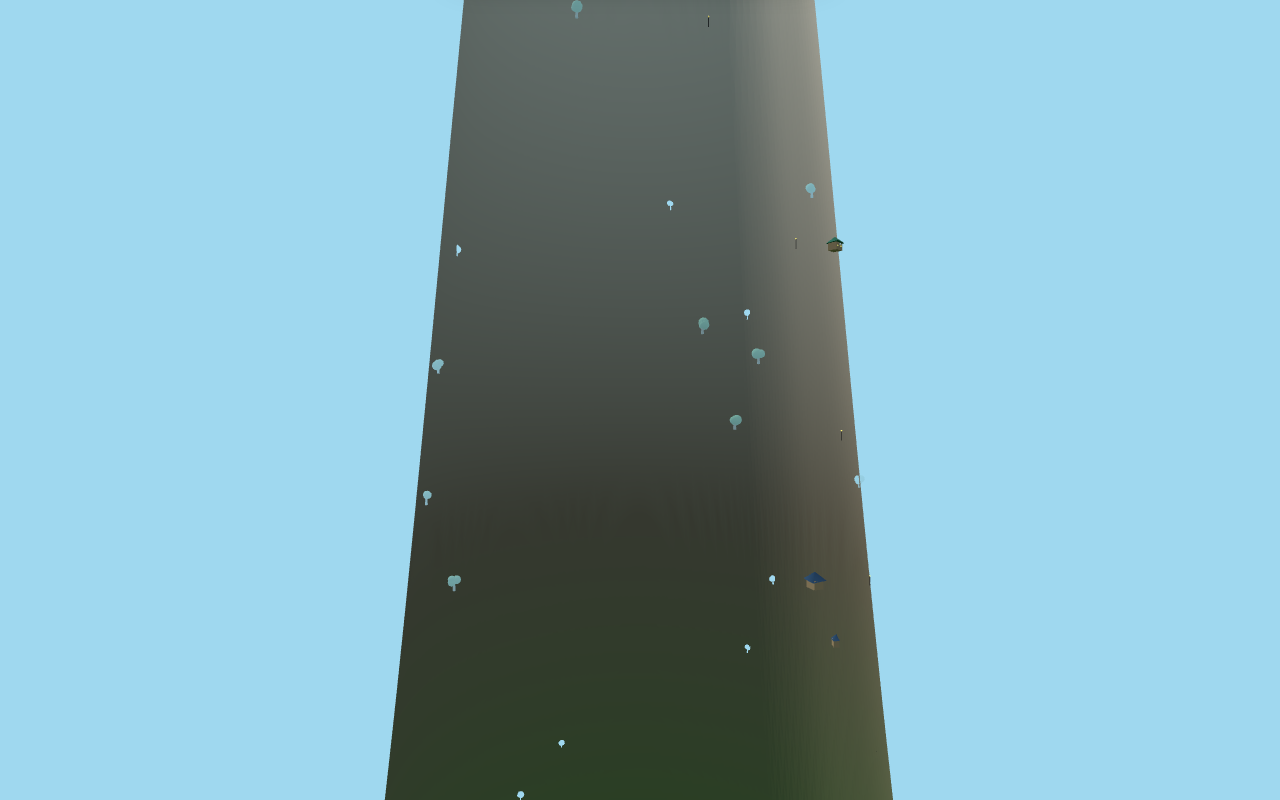
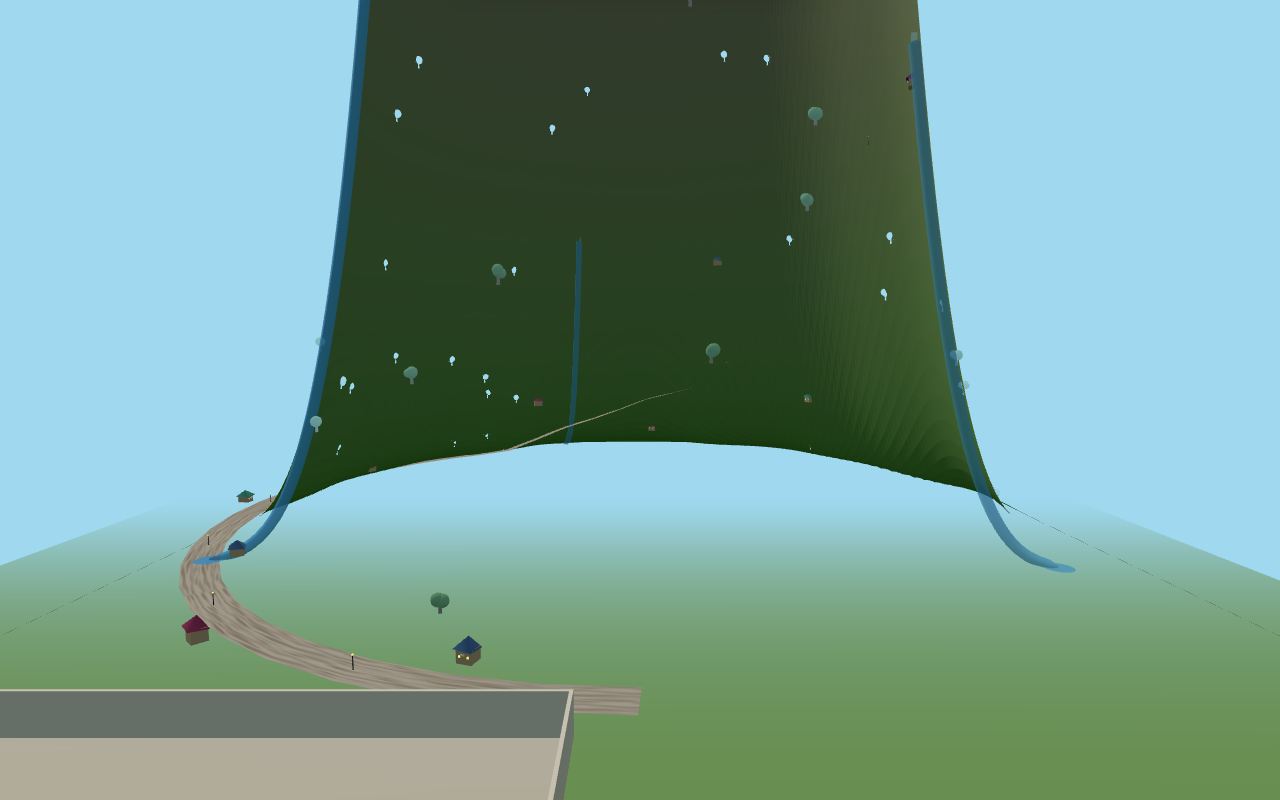
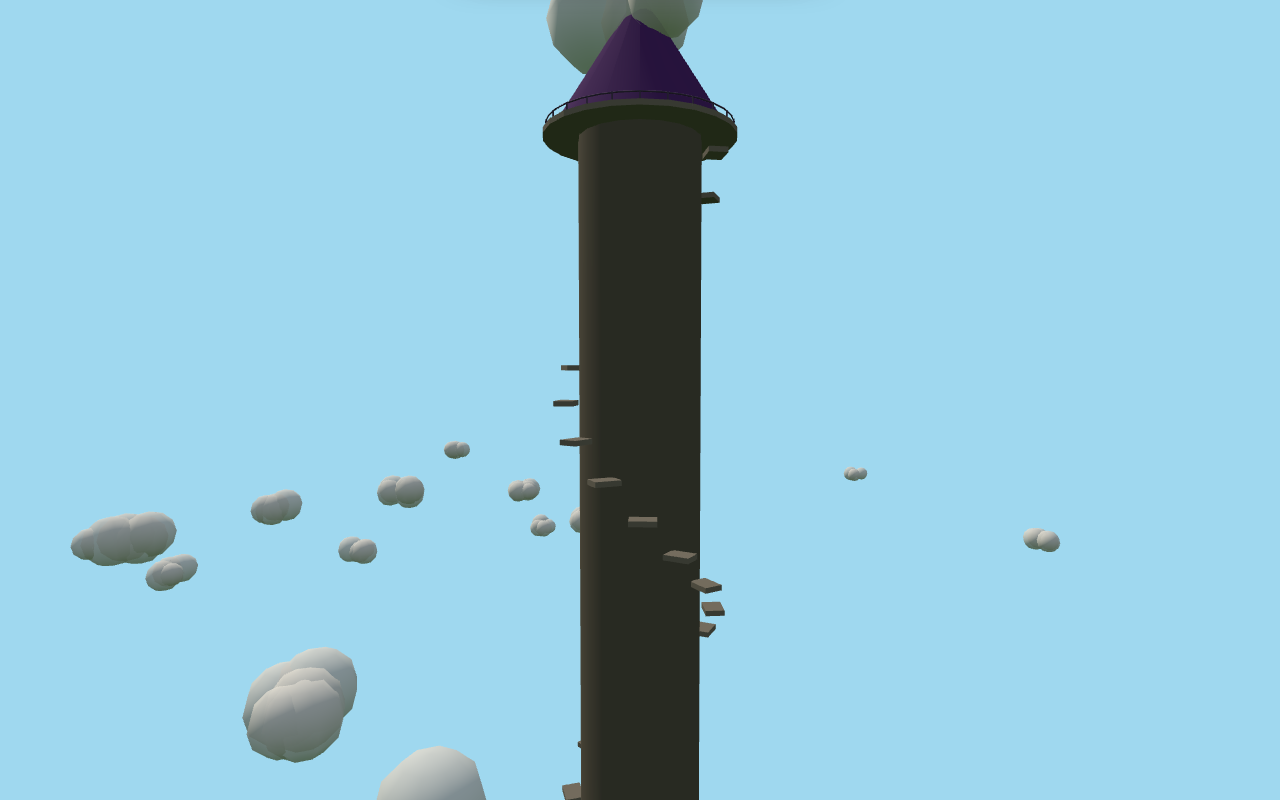
My read of the three world shots — structurally complete, but the feel is far off, as expected for a first pass:
- From the plaza: a dark green wall.
r 105forh 520makes a near-cylinder; the profile needs a wide skirt rising to a steep peak, with the base allowed to run off the map to the west so the visible face has a real slope. - Foot of the road: the road is a good start — cobbles, lamps, cottages — and the streams work, but everything above the first bend is a green slab with a hairline spiral.
- Tower top: a plain dark chimney; the ledges are too small to read; the clouds are scattered blobs, not a deck.
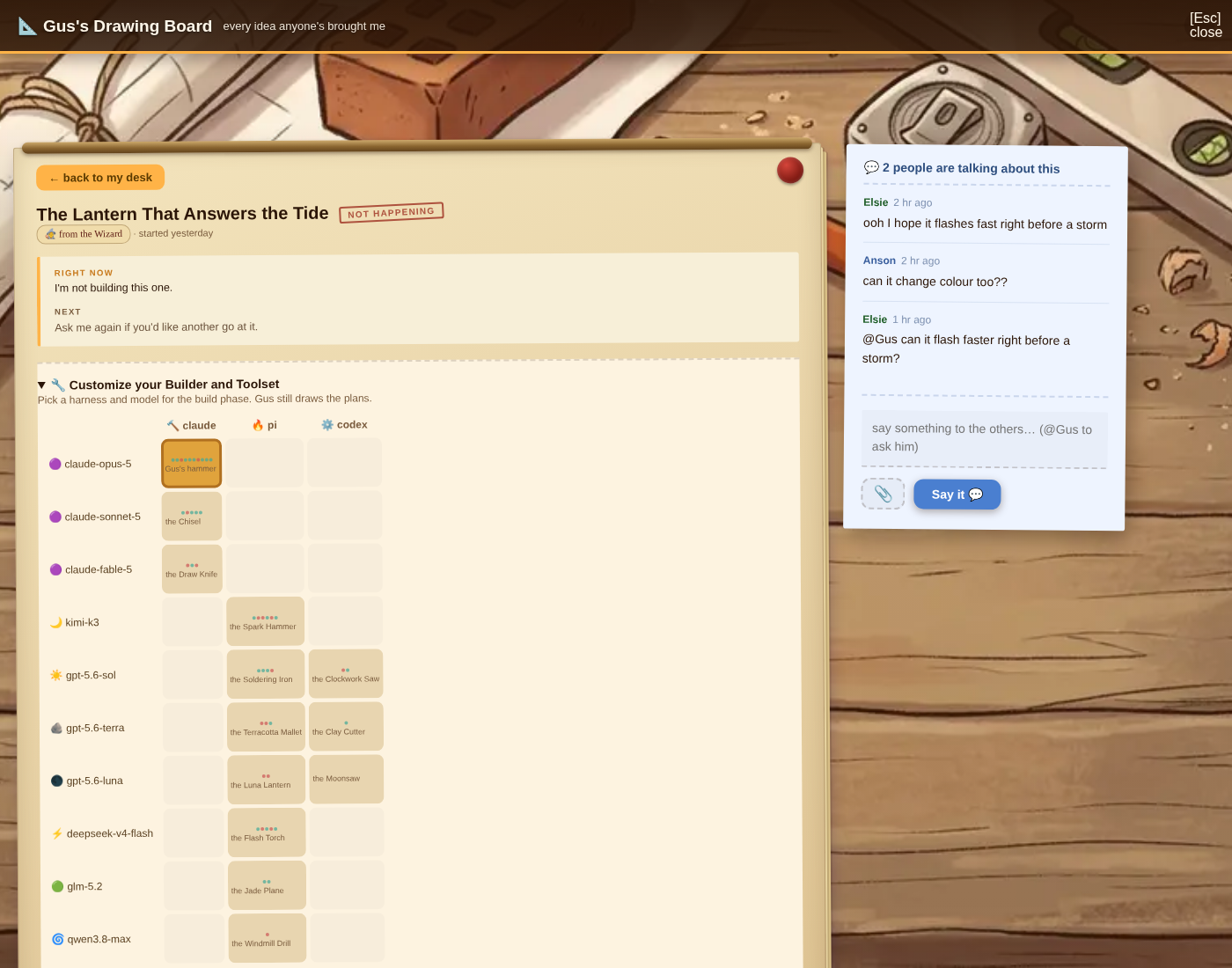
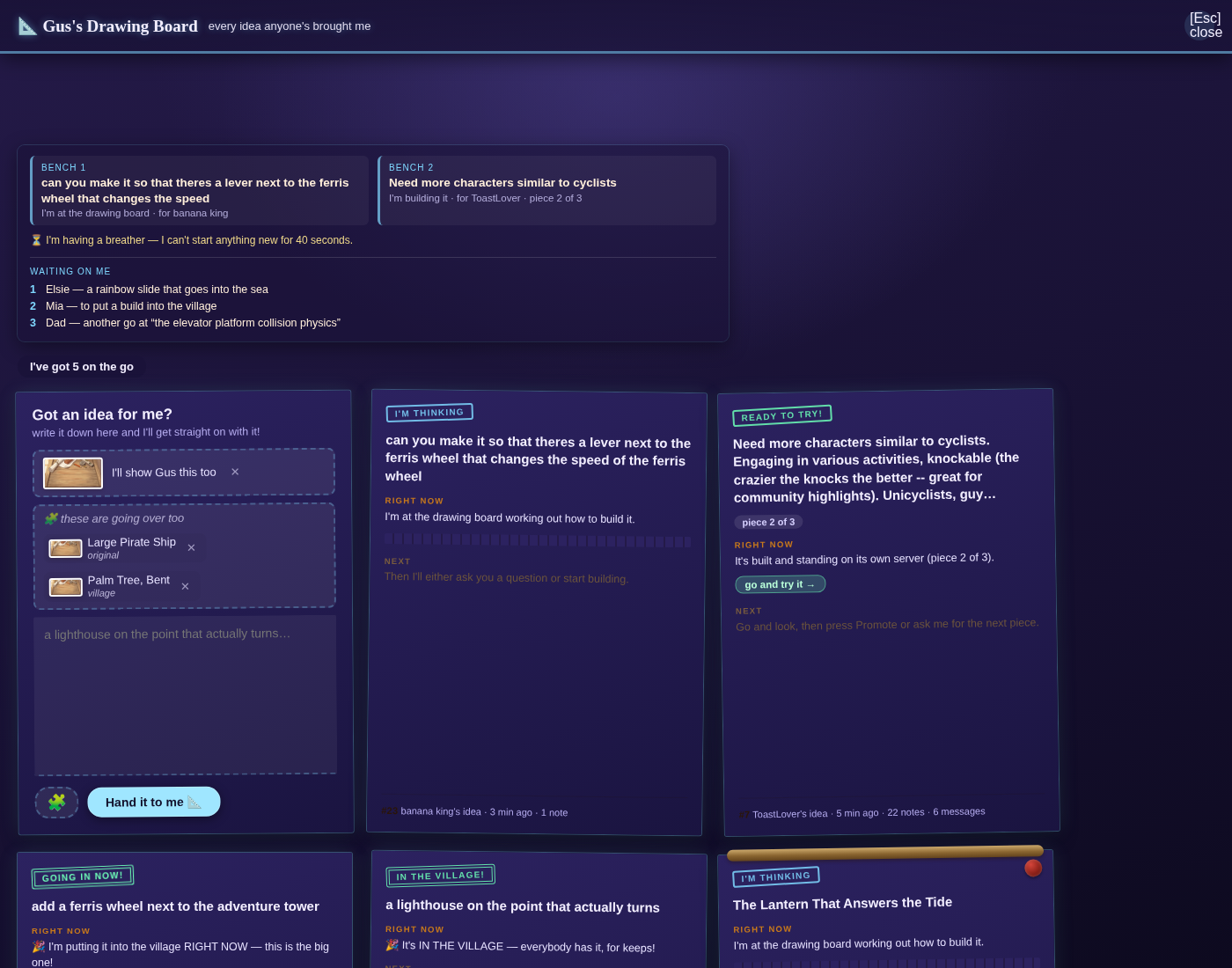
The scroll and the ball skin I’d like you to judge yourself — the reskin brief was “only a reskin”.
The code review came back with fifteen findings, and several explained the shots: the mountain mesh was wound backwards and rendering inside-out — the “dark wall” was the far inner face — nobody could jump on the slope so the first ledge was unreachable, the carpet landed inside the tower, the roof swallowed the crystal ball, the ledge hit-boxes were rotated wrong. Claude split the fixes by file: a browser fix round now, the server findings folded into the Wizard’s-brain round, both launched in parallel.
Remember: you have to stay high level. I love the vision you’re painting
Understood — I’ll stay at the level of the vision and the vistas, and let the sandboxes and their reviewers carry the details. From here on I’ll only surface what changes the picture: the shots, the shape of what landed, and the decisions that are yours.
The top of the tower should just be open with archer notches and vertical spires
Sent to the fix round as an override: no roof — an open top ringed by battlements with archer notches, and slender spires rising from the parapet, the Wizard and his ball under open sky.
Yeah kid could help pick ideas to build. Idea generator can generate faster than build
That’s a good turn — it also gives the A/B loop its best signal (which variant’s ideas do kids actually pick). Steering A2 now: the judge posts a shortlist of visions instead of one winner; kids vote at the crystal ball; the twice-a-day drop carries the most-voted one.
Big time engagement
Agreed — voting is the engagement signal that isn’t a proxy: a kid saying “that one” is the human feedback the whole pipeline is built to learn from. The addendum makes votes a first-class stat per variant, so the A/B table reads “which muse-mix do the kids actually choose” from day one.
The shape now: a dream fills the crystal ball with three visions; kids vote (one each, movable); twice a day the dew drop carries the most-voted one to Gus; the losers stay in the ball for the next round, and the pool retires the ones nobody picks.
Need a fyp basically, including personal ideas for each player
A “for you” feed is the natural end state: every kid opens the ball and sees visions the Wizard dreamed for her — from where she actually spends her afternoons and what she’s asked Gus for — above the village’s visions and everyone else’s. Steering A2 to add the personal layer on top of the vote pool.
Things they’ve liked in the past
Love that mapping to the Wizard interaction
Good — the mapping holds all the way down: the crystal ball is the Wizard’s way of reading the village, so the feed is literally what he sees when he looks into it, and a kid looking in sees herself looked at. A2 has all four addenda (visions, votes, for-you, liked history).
The fix round came back. Its four vistas, after the mountain was turned right side out:
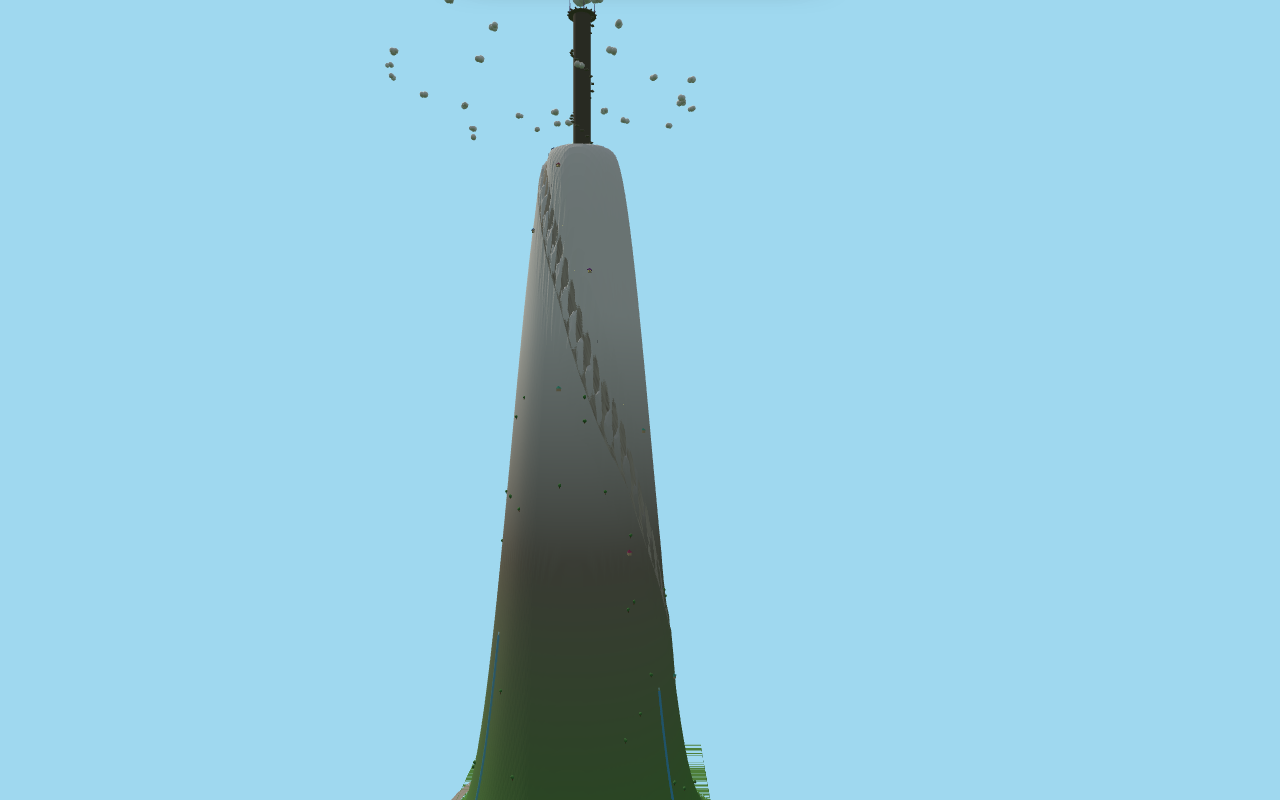
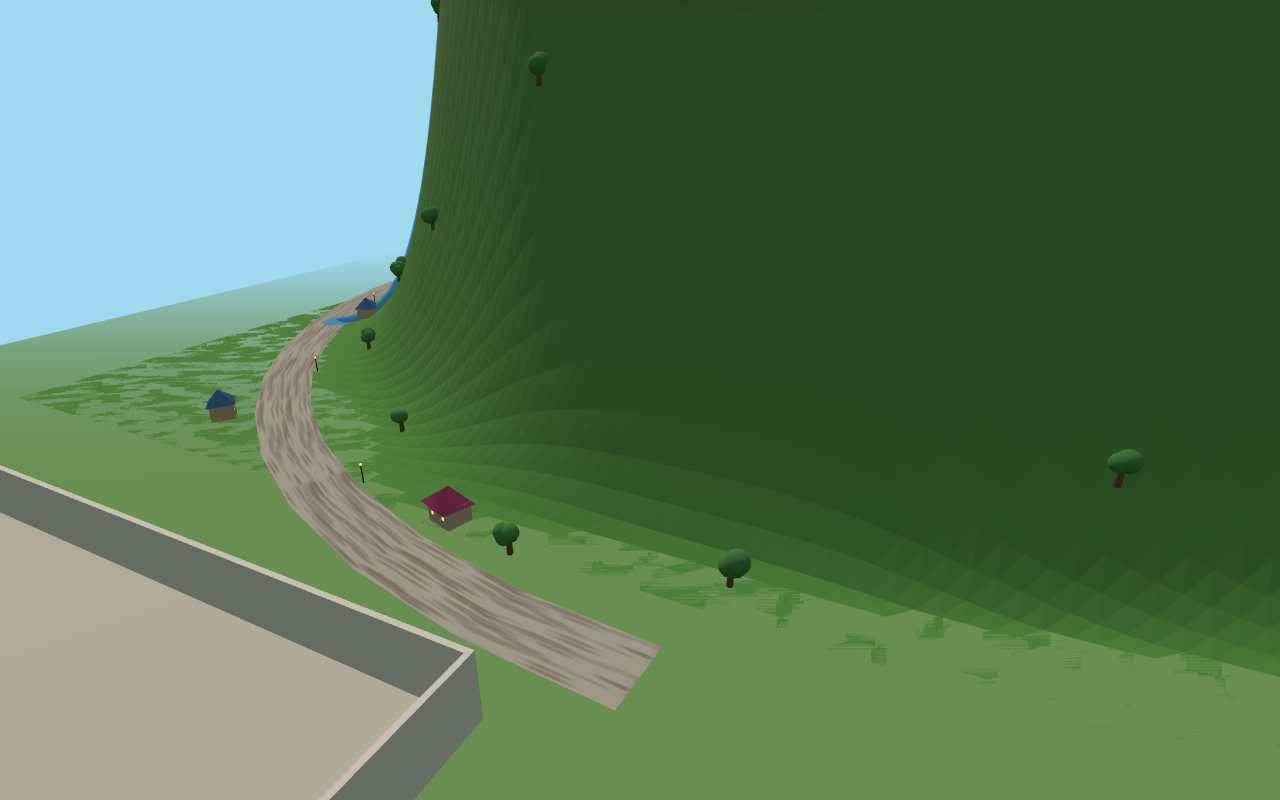
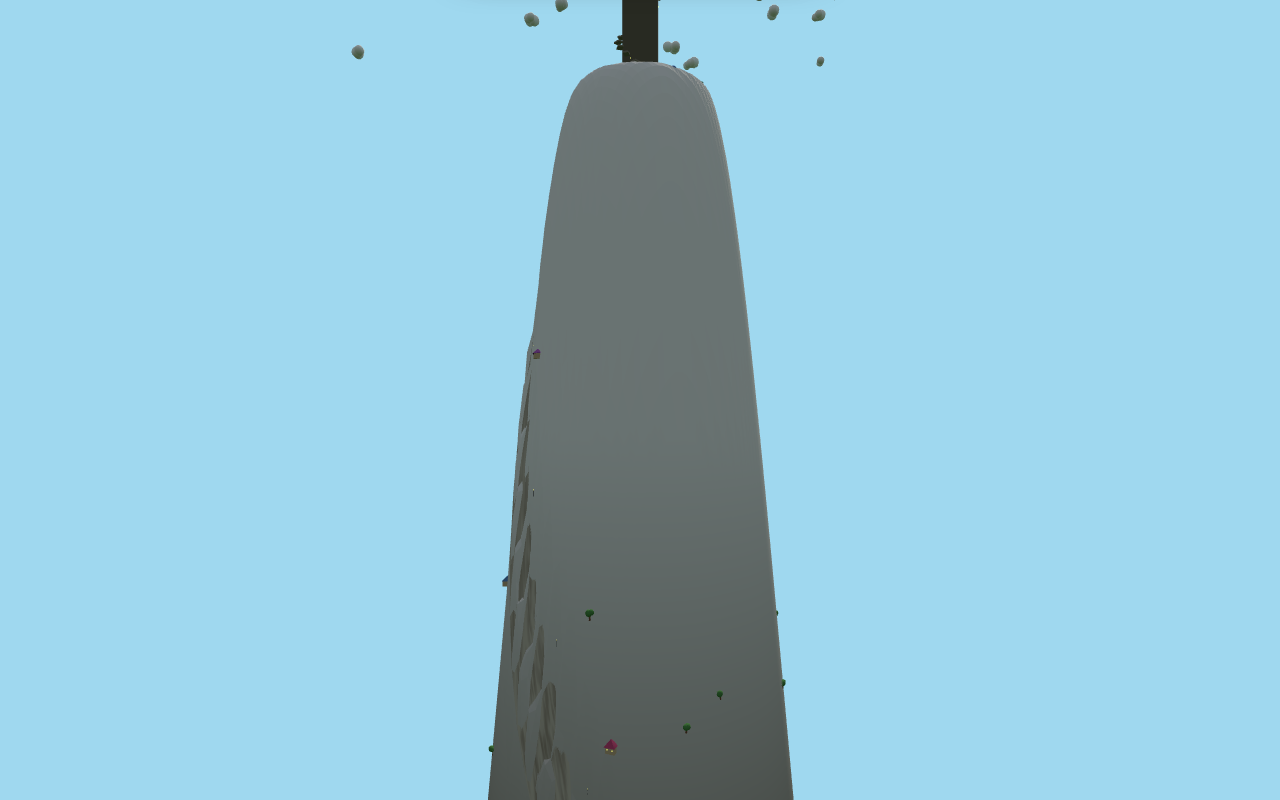
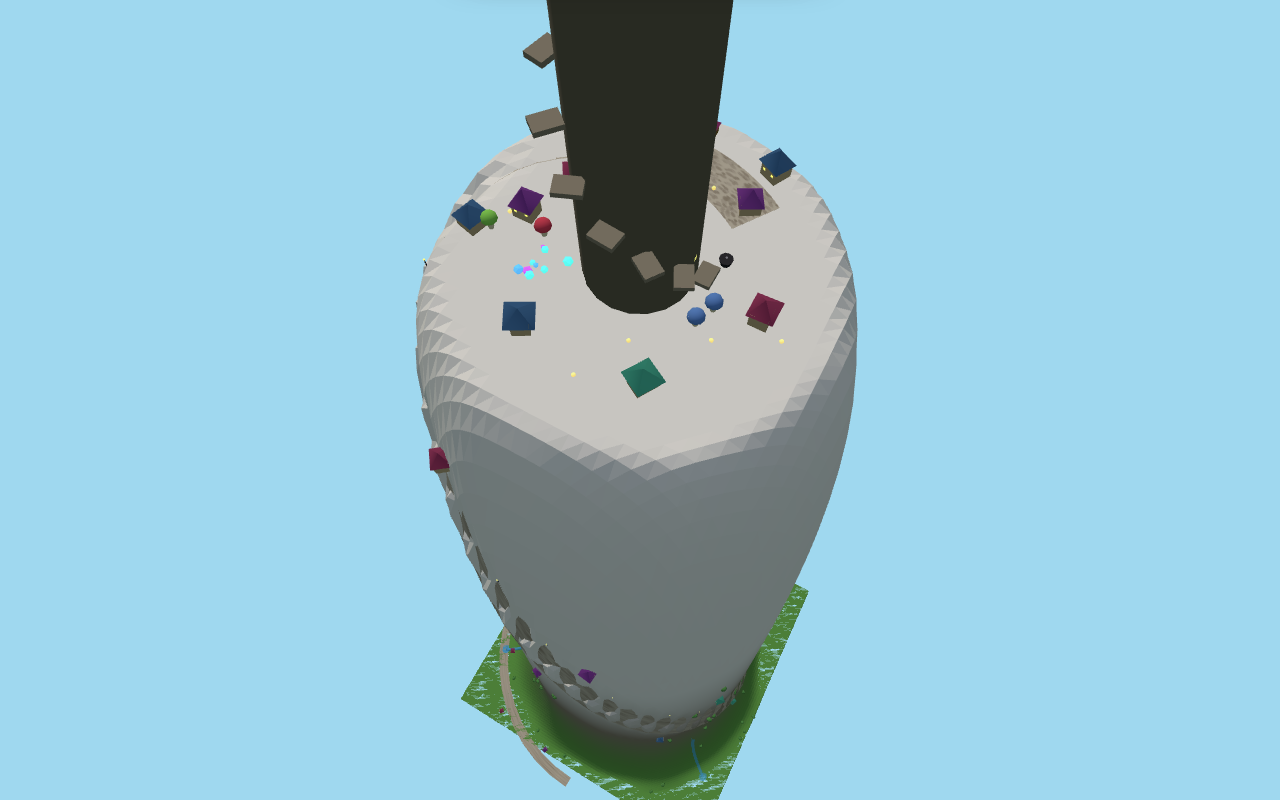
It’s right side out now, and the road reads. From the plaza the mountain finally has a front, the Royal Mile’s shelf winds visibly up it like a thread, and the tower sits on top with the cloud ring around it. At the foot the cobbled road, lamps and cottages are a real place to arrive at.
But it’s a thumb, not a mountain. Three things make that, and they’re the whole of the next vista pass:
- Silhouette. The plateau flattening rounds the summit into a dome, and the base is too narrow for the height, so the profile is a monolith. It wants a broad skirt of foothills rising to a peak — with the plateau a shoulder just under it, not the top of the dome — and one or two ridgelines to break the outline.
- Surface. The slope is one smooth vertex-coloured skin: no rock, no snow line, no crags. It needs banded stone, scree, a snow cap that starts at a real line, and enough noise that it stops looking machined.
- The road cut is too deep and too regular — from mid-road the shelf reads as a screw thread. Shallower, irregular, tucked into the rock, with the cottages hugging it, and it becomes a street instead of a groove.
From the balcony the summit village is charming in miniature — houses, cauldron, the crystal garden — but the cloud deck isn’t in frame yet, and the tower’s stone is a plain dark tube.
Two steers I’d like from you before I brief vista pass 2: the mountain’s character — a broad-shouldered giant with a sharp peak, or a lone needle with the tower as its point? And the clouds — a solid sea you climb up out of, or a broken deck you can see the village through?
Need a “protect my username” feature that sets a password on your account. Totally opt in.. Default is still any username. Remember – YOU stay high level
Understood. That one is timely — once the crystal ball knows what Elsie likes, “Elsie” has to be able to belong to Elsie. Briefing it as its own round: opt-in, per name, nothing changes for anyone who doesn’t ask.
The shape: a “🔒 Protect my name” control on the dressing-up screen, a password field that appears on the join card only when a name is protected, a grown-up’s village.sh unprotect for a forgotten one, and the doc line changed to say a lock decides who may be a name and nothing about what the name may do.
CNPG should be available if needed
Noted. For this round the save file and wizard.jsonl are the right home — everything the running village needs is bounded and it rides to previews with the seed. Where CNPG earns its place is the Wizard’s long memory: every idea, vote, outcome and lesson across months, so the A/B question (“which muse-mix do kids pick, and did it hold up after shipping?”) is a query rather than a log scrape. I’ll have A2 write that boundary into the docs so the next round can pick it up cleanly.
I’m begging you to stay high level
Would love to ship tonight
Then here’s the path: as D1, A2 and E land I fold each into the branch and run the suite; once A2 is in I launch the last piece — the crystal ball’s for-you feed with the vote button — against the real wire; then a final review of the merged branch, and push to main for CD. The village reloads once with the whole Wizard in it, and Dot writes one post-it. I’ll tell you when it’s on its way.
Do the ones going on an hour need a nudge to freshly forked
Check their context usage
Do sandboxes have the ability to self refresh (like freshly forked)?
Could we add support by nudging the agent when 50% context usage is reached, to instruct it to write a hand-off in the outbox and the outer loop calls the harness again immediately upon exit of the last one. Process outbox hand-offs by re-invoking the agent. Loop until empty
This is where the side requests start. The answers, compressed: no nudge was needed — the hour was the whole run’s clock and each review leg starts a fresh session; the three runs sat at 170k, 192k and 94k tokens of context; and no, a sandbox could not refresh itself — it had compaction and the review loop’s per-leg freshness and nothing else. So Claude briefed a sandbox round against the fork-sandbox repo itself to build exactly what I’d sketched: a nudge at half the context window through the addendum channel that already existed, a hand-off written to an outbox, and the runner re-invoking the harness on the same clone until the outbox came back empty. It launched at 06:38, beside the three village rounds still in their review loops.
This high level interaction mode should be the default (–long). I’m begging you to make it clear that we stay high level
A docs-only sandbox round wrote a “Stay high level (the default; --long)” section into the sandbox-coder-mode skill — $0.36.
Sent. From here: high level is the default, the sandboxes carry the detail, and you won’t need to say it again.
A2 landed: the Wizard’s brain, +2,500 lines across 23 files, review loop ended “no-progress” (findings left standing). Reading the verdict’s headline and the two shell scripts, then merging and briefing the last piece.
The Wizard’s brain is merged onto the integration branch. Two rounds launched from it, in parallel:
- A3 — the three things the review caught that would have cost real money or run on previews: the muses were only being shown a fifth of “what already exists” (and never what he’d chosen recently), every preview server would have dreamed and dropped on its own clock, and the personal muses were fed an uncapped ledger eight times a dream.
- D2 — the last piece for tonight: the for-you feed inside the crystal ball, with the vote.
Still in flight beside them: D1’s second review, E’s review, and F on fork-sandbox. When D1/E/A3/D2 are all in, I run the suite once more and push.
Could we build a workflow with sandboxed agents to implement a mailing list (lkml) style code review and patch series iteration model. Asynchronous, parallel, some back and forth. It has to unfold autonomously, including convergence (max depth 30) no max in number of replies, can always append more. Same as a mailing list. Call it /lkml-mode. You would get the cover page and thread tree and would orchestrate replies. Could potentially benefit from sandbox resume. Same harness and model per “persona”. Linus Torvalds is a frequent top-level reviewer. Build a full panel of reviewers tailored for the work being done, but always include Linus, no matter the task. AI self attribution will be important. They’re actually feeding into a mailbox style shared filesystem synchronously with message UUID. You stay at the highest level, just the shape of the discussion.
Briefed as a sibling of the self-refresh round and launched against fork-sandbox in parallel with it. The shape Claude described back: a series is a cover letter plus [PATCH vN i/M] messages in a mailbox — one file per message, UUID’d, threaded by In-Reply-To, every From: stamped as an AI persona with its harness and model in the headers; a panel is a set of persona files each pinned to one harness and model, Linus always on it; a round is one sandbox per persona in parallel, each replying on-thread; the author is a persona too and posts v2, v3… with a changelog; convergence is Linus plus one other Reviewed-by on every patch, no NAK standing, nothing open. Seven sandboxes were running at that point.
Wizard should be named Merlvin. Purple color scheme in builder UI and preview overlay
Merlvin it is. That round touches the same files A3 and D2 are still reviewing, so it goes right after they land — one rename-and-recolour pass over the server, the desk, the ball and the preview bar, then the final suite and the push. I’ll queue it now and launch the moment the branch is whole.
Over the next hour the two tooling rounds landed and were installed: a run can now refresh itself at half its context window (1,313 lines, 41 assertions), and /lkml-mode exists (a mailbox, rounds, an author’s respin, a status screen, seven personas). The Merlvin round was the first to run with self-refresh on by default: 17 commits over seven legs for $0.83.
Shipped. Prod is running 986aef6: the mountain and the Royal Mile, Merlvin’s tower and crystal ball, the engagement ledger, the visions pool with voting and the for-you feed, protected names, the purple previews — plus the kid’s baby-you fish that landed while we were merging. Merlvin’s endpoint answers on prod; his pool is empty because the first dream is scheduled 45 minutes after boot. scripts/event.sh wizard fires one now if you’d like to watch the crystal ball fill tonight.
Still running: the follow-up round for the two leftover review findings (the /servers.json assertion and the vote-vs-feed race); it lands as its own small push.
Pushed — bc3cfe3c2a; CD is rolling it (a server change, so the village restarts once). That closes tonight’s list.
Where things stand:
- Prod: Merlvin, his mountain and ball, the ledger, visions with votes and the for-you feed, protected names, purple previews — all live. His first dream fires 45 minutes after boot, or now with
scripts/event.sh wizard. - fork-sandbox: self-refresh and
/lkml-modemerged on localmain, installed, tests green — not pushed to GitHub until you say. - Next rounds when you’re ready: vista pass 2 (I still want your two steers — giant-with-a-peak or needle; sea of cloud or broken deck), life on the Royal Mile, and the climb rhythm judged by Elsie.
That was 2:35 in the morning. By the time I came back, Merlvin had dreamed on his own: three visions in the crystal ball. The first one he chose — “Leap of Faith, Landing Included”, a parachute lever on the tower’s parapet — had already been built by Gus and promoted by a kid before anyone at the workbench saw it.
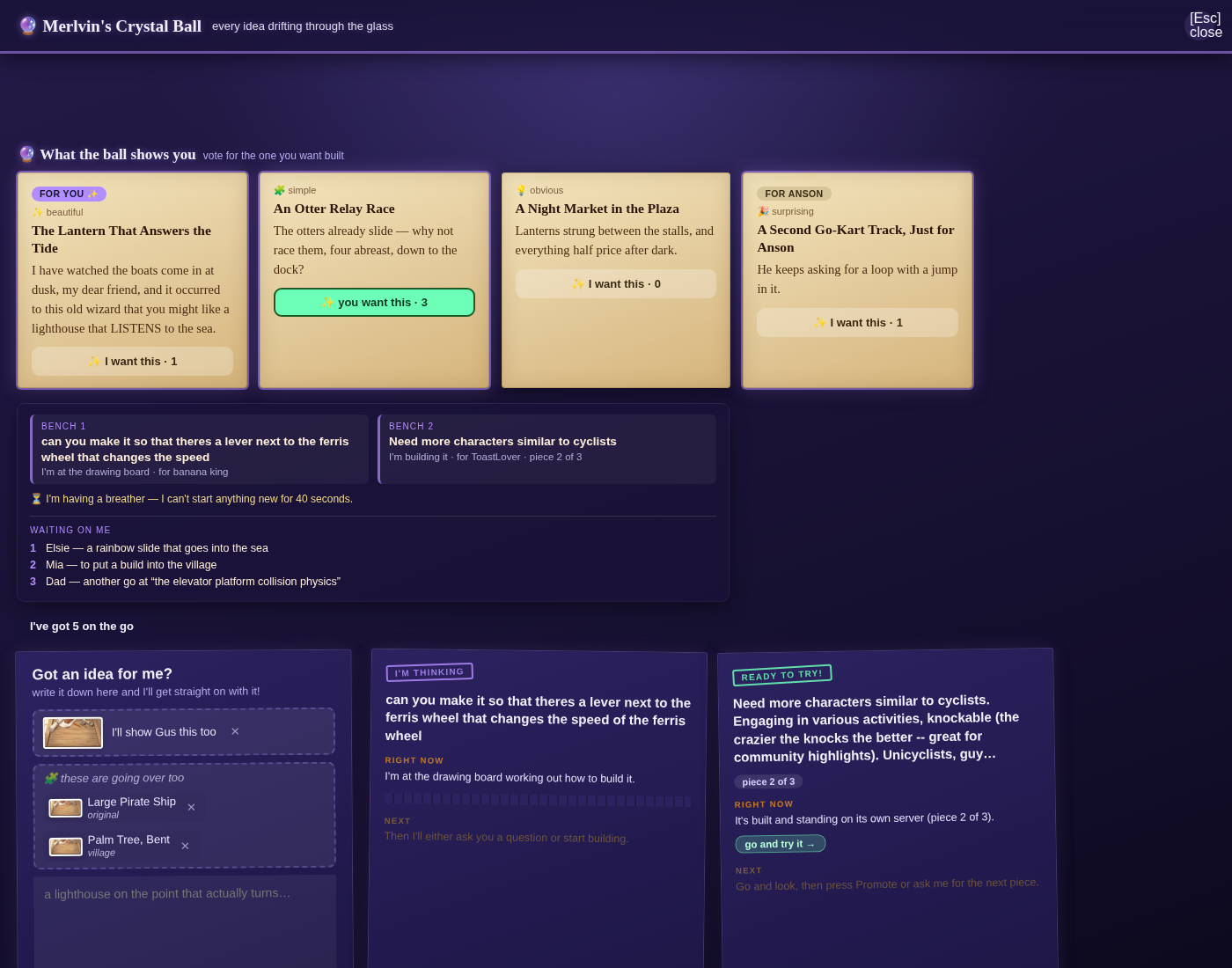
Really fantastic run of implementation 👏
Has anything come out of the crystal ball yet?
Broad shouldered giant for the mountain peak.
I realize this has already shipped but the last thing I’d like you to do while you have both the vision and implementation fresh in your context is drop into /lkml-mode for a final review of the implementation. The cover page (written by a sandbox) should prelude the entire thing we built (merged already, it’s okay) with narrative description and implementation overview (like an lmkl cover letter), screenshot attachments, final smoke results, full diffstat (that’s part of lkml/git-pull-request cover pages, right?). Once the cover page is ready you can kick off a few top level reviews of each patch, invoking the “author” to reply, then giving reviewers a chance to respond, and so forth until convergence. The author can respin the series a number of times (rewriting its branch), but in the end we’ll have to just forklift the diff in since this is actually a post-hoc review. Make sure the above flow is supported in /lkml-mode first before launching. All the while you monitoring through the rendered thread replies (author/subject) and any cover page respins.
Once the thread has settled/materialized, this is your opportunity to “click on” different parts you want to review. Top level patches as well as any review threads you think look interesting. You should also pitch in on the thread as you see fit, this is your opportunity to actually shape the implementation. This is a critical moment since the vision needs to transfer to the implementation as losslessly as possible. You’re the only one that can bridge those two things.
Deploy any follow ups to the village and let me know when it’s ready for my play test.
Once /lkml-mode is battle tested with the above, push the fork-sandbox repo.
Thank you — and yes, this is the right moment for it: a mailing-list pass is how the vision gets argued into the implementation rather than assumed. Plan: check the crystal ball; read what /lkml-mode actually supports today against the flow you described; extend it where it falls short (a sandbox round on fork-sandbox); then run the review on the shipped work, with me in the threads.
I’m hoping this allows you to stay high level while also getting into the implementation. Time to flex and burn that sweet context we’ve been preserving.
Side work again, compressed: /lkml-mode as built could review a branch in progress but not re-roll something already merged, so a sandbox round went out to add that — re-rolling a shipped range into a thematic series, an author-written cover letter with attachments, a diffstat and smoke results appended by the host, and a “forklift” to land the final respin’s delta onto main as one commit. Meanwhile Claude wrote two reviewers tailored to this series for the panel: a child-safety reviewer and a game-feel one.
Panel is ready to launch the moment J lands: Linus, architecture, security, tests, docs, newcomer, plus the two I wrote for this series — a child-safety reviewer (every model-to-child path, identity, personalisation as a magnifier, cost as safety) and a game-feel reviewer (the narrative as the spec, climb rhythm, reveals, silhouette, sound, performance). The author on opus. Waiting on J.
Elsie wants a rename to Mervlin
Pencil broke on a recent build request from Elsie
Looking into Elsie’s broken pencil now — that’s a plan round dying on her idea, and it happened after our deploy, so it’s mine to rule out first.
The owl’s pencil is fine: the plan round finished and the build started at 15:16 (Opus on the hammer). Elsie should have a preview of the owl in about twenty minutes.
Still in flight: J (post-hoc lkml tooling, first commit in) and K (the Mervlin rename).
I’m play testing with Elsie now. This is a ton of fun. The mountain top village needs a lot more space though. The Royal Mile should actually be on top of the mountain, straight road with a gradual ascent. Space for a few dozen houses and shops. Two story shops. Needs to feel more tunnel like. Just like the Royal Mile area in Edinburgh. Village feels empty now. Needs more like and adventure. Add “quests” the player can take on. First one could be retrieving Mervlin’s feather quill, which has blown off the tower. Badges/accomplishments you can accumulate.
The mountain is also insanely steep. The current mountain needs to be part of a larger mountain range (base of the range should be ~10x the size of the base of the current mountain). That should allow the slopes to be much more manageable. The road going up the mountain has some physics issues, btw, the character kind of sinks into the ground when walking on the road that goes up the mountain.
Both launched — the range and street on Opus (the feel decides this one), quests on Sonnet. Also still going: J (the review tooling) and the suite for the Mervlin push. While you play: the crystal ball, the parachute lever and Leap of Faith are all live now; the rename reaches prod in a few minutes.
Then the orchestrating session’s own context hit 81%, and it did to itself what it had just taught the sandboxes to do: wrote a hand-off and started a fresh session in the pane below. The next message is to that session.
Give me the current vision so I can verify hand-off preserved everything
Here’s the vision as I hold it.
Mervlin. Far west of the village — past the fields and the garden store, where the island used to end — a mountain stands with a tower above the clouds. Mervlin lives in it. Elsie named him (he was “The Wizard”, briefly “Merlvin”; the game now answers to all three for old paper, but says Mervlin).
He dreams. Twice a day he reads how the village is actually played — the engagement ledger of who did what, the git history, Dot’s bulletins, the desk — and four muses on four different models each look at it through a lens: beautiful, simple, obvious, surprising. A judge shortlists them into visions. Rejected ideas are written down and never shown to a muse again; they only come back as “lessons” for the judge, when the village goes and builds one of them anyway. Two muse-mixes alternate, A and B, so we can tell which dreams better.
Kids vote. The visions sit in his crystal ball — Gus’s desk wearing a different skin, with a for-you feed that puts a kid’s own kind of idea first. A dew drop falls twice a day carrying whichever vision has the most votes down to Gus’s desk, where it becomes an ordinary docket. His dockets are parchment scrolls; his builds wear purple; only one of his ideas is ever in flight at a time. He predicts, he does not decide.
He has already worked. Three visions are in the ball on prod. His first chosen one — #127, “Leap of Faith, Landing Included”, a parachute lever on the parapet — was built by Gus and promoted by a kid. It’s in the village. Elsie has since asked for an owl at the mountain’s foot that flies you to the tower (#128, building now).
Alongside him: a kid can put a password on her name (“protect my name” — it changes who may be the name, nothing about what the name may do), and the engagement ledger exists because he needed something honest to read.
Where the mountain is going (in flight — the range). Your playtest verdict: the mountain is a cliff, 81° on average. So it’s being regrown as a range — a broad-shouldered giant with a sharp peak, a skirt about ten times wider, five lesser peaks off to the west and south-west. The island grows west to make room. The summit stops being a point and becomes a ridge, because that’s where the Royal Mile goes: moved on top of the mountain, a straight street rising gently from a gate at one end to the tower at the other, 30–40 two- and three-storey shops shoulder to shoulder, closes between them, tunnel-like, Edinburgh. The road up switchbacks at ~14°; the street is walkable; the flanks are steep and meant to be. The sinking-into-the-road bug was fixed first (11 units of sink down to 0.19), and the parachute’s landing has to survive the wider skirt. Four vistas come back with it: plaza, gate, street, top.
Steer given: shape of the giant. Steer not yet given: the clouds.
What Mervlin asks of you (in flight — quests). His feather quill blew off the tower. A kid finds it glowing on the mountain, carries it — everyone else sees it on her back — and returns it to him for a badge, which goes on a 🏅 shelf. Quests are a registry any villager can push a job onto; badges are a catalog. Built and passing; gaps are that the quill isn’t yet drawn on another kid’s back, and the handshake has no test of its own.
After that, in your order. Both of those land on prod → “ready for play test”, with the four shots. The post-hoc LKML review of the whole Mervlin series — cover letter with narrative, screenshots, smoke, diffstat; Linus and seven others including a kid-safety and a game-feel reviewer; you in the threads as the operator; respins until it converges; then forklifted onto main. Push fork-sandbox to GitHub once that review has battle-tested it. Life on the Royal Mile: villagers with voices — an apothecary, a broom-seller, a riddling cat — ambient sound, things to do in the shops. More quests. A vista pass judged by shots.
Standing rules I’m carrying: stay high level; every edit is a sandbox run; push to main without asking whether kids are on; never a real name on the wire; village knowledge goes in the repo, not my memory.
Made possible by sandbox-coder-mode, part of fork-sandbox.
Links
Projects
Work
- Co-Founder & CEO of Directangular, LLC.
- Previously: Linux Kernel development at Qualcomm, and embedded software at L3. You can view my upstreamed Linux kernel patches here.
- Wild blue yonder: Creating and contributing to a variety of Open Source projects. See my GitHub profile.
 Subscribe with Atom